CAN buses need proper termination and topology; missing termination looks like a software problem.
CAN field bus module
MCP2515 ESP32 wiring, pinout and CAN bus setup
Wire an MCP2515 CAN module to ESP32, check SPI, CANH, CANL and termination, and use ESP32 Bit Pirate for CAN bus sniffing and controlled frame tests.
Start here when wiring an MCP2515 CAN module to ESP32 for SPI controller checks, CANH/CANL wiring, termination and controlled bus receive tests.
- CAN
- sniff
- send
- MCP2515
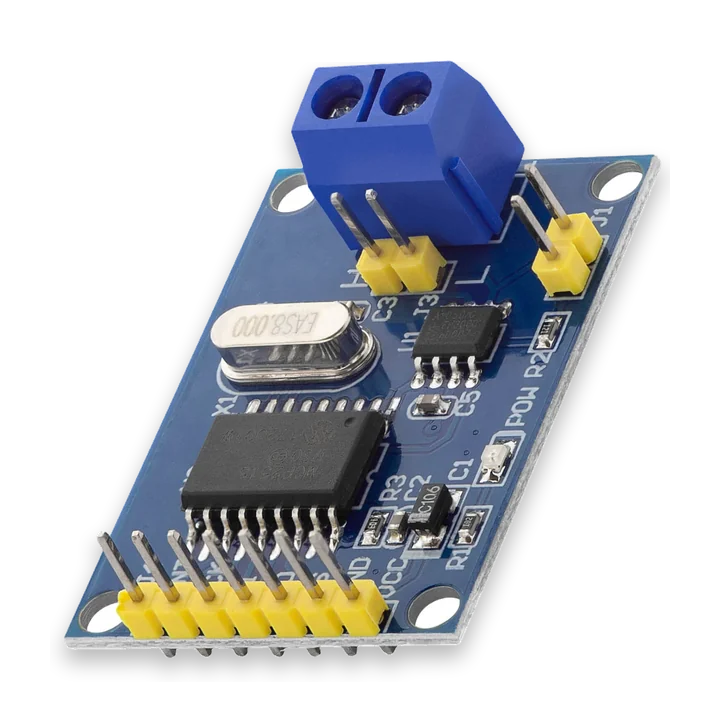
pinout photos
MCP2515 CAN pinout photos for ESP32 wiring
Compare your MCP2515 CAN board with these reference photos before wiring. Generic CAN breakouts can differ around the SPI header, INT pin, CANH/CANL terminal and 120 ohm termination jumper, so confirm the silk-screen before applying power.
CAN and SPI wiring
MCP2515 ESP32 wiring, CANH/CANL and termination checks
Use the MCP2515 module only after confirming both sides of the board: SPI wiring to the ESP32 and CANH/CANL wiring to the test bus.
| MCP2515 module pin | ESP32 Bit Pirate / bus connection | Check before sniffing |
|---|---|---|
| VCC / GND | Module power and common ground | Confirm the breakout voltage and share ground with the CAN test setup. |
| SCK, SI, SO | Selected SPI pins | Match ESP32 SPI wiring before checking CAN traffic. |
| CS | Configured chip-select GPIO | A wrong CS pin can make the controller look missing. |
| INT | Input GPIO when required | Wire interrupt only when the firmware workflow expects it. |
| CANH / CANL | CAN test bus high and low | Do not swap the pair; verify bitrate and that the bus is authorized for testing. |
| 120 ohm termination | Bus end termination or module jumper | Enable termination only when this module is at a bus end; avoid extra termination on an already terminated bus. |
workflow
Start with passive CAN status checks
Confirm SPI wiring, CANH/CANL order, common ground, termination and bitrate before attaching to a bus. Start passively with controller status and receive/sniff checks, then send only controlled lab frames.
- 01
Wire SPI plus the CAN transceiver side with proper CANH, CANL and ground reference.
- 02
Confirm module power and transceiver voltage before attaching to a bus.
- 03
Check controller status before sending frames.
- 04
Start passively with sniff/receive flows on authorized buses.
- 05
Send only controlled lab traffic with a known bitrate and arbitration ID.
Example CLI flow
mode can
status
sniff
send 123 01 02 03 04
Use this MCP2515 sequence for passive CAN setup and receive checks before any controlled frame transmission.
hardware reminders
MCP2515 CAN wiring notes before bus access
Confirm MCP2515 SPI wiring, INT, CANH/CANL order, common ground, termination and bus bitrate before CAN traffic.
Wiring View
The module and bus must use the same bitrate.
MCP2515 boards vary; confirm the transceiver voltage and board pinout.
Before wiring a module or target chip, check pinout, voltage, ground reference and whether the selected ESP32-S3 board has the required pins free.
task-level guides
Detailed MCP2515 CAN module recipes
Use these MCP2515 guides for CAN wiring, bitrate checks, passive receive and controlled lab frame sends.
Wire MCP2515 CAN module
Task-level guide with wiring, commands and troubleshooting steps.
Check MCP2515 CAN statusTask-level guide with wiring, commands and troubleshooting steps.
Sniff CAN framesTask-level guide with wiring, commands and troubleshooting steps.
Send a CAN frameTask-level guide with wiring, commands and troubleshooting steps.
Receive a specific CAN frame IDTask-level guide with wiring, commands and troubleshooting steps.
what it is
What MCP2515 is used for
MCP2515 modules add a SPI-connected CAN controller and transceiver path for lab CAN buses and embedded field-bus experiments.
practical value
Why use MCP2515 with ESP32 Bit Pirate
ESP32 Bit Pirate turns the module into a practical CAN bench path for wiring checks, status reads, controlled sends and receive/sniff workflows.
common symptoms
Common problems with MCP2515 CAN module
MCP2515 failures usually come from SPI wiring, oscillator/bitrate mismatch, CANH/CANL order, missing termination or bus-off state.
No frames
Check CANH/CANL order, bitrate, termination, ground and whether the bus is active.
SPI responds but CAN is silent
The controller can work while the transceiver or bus wiring is wrong.
Error frames or bus-off
Stop sending, check bitrate and confirm you are on an authorized lab bus.
pages
Useful MCP2515 next pages
Use these links for MCP2515 wiring, controller status, CAN sniffing, controlled send tests and hardware notes.
CAN
CAN reference for bitrate, sniffing, frame format and controlled sends.
SPISPI reference for MCP2515 controller wiring and register access.
ESP32-S3 DevKitBoard-specific notes for using MCP2515 CAN module with ESP32 Bit Pirate.
Wire MCP2515 CAN moduleConnect SPI, power and CAN transceiver lines.
Check MCP2515 CAN statusVerify bitrate, oscillator and controller state.
Sniff CAN framesCapture live CAN traffic from a lab bus.
Send CAN frameTransmit a controlled CAN frame for testing.
Web Serial TerminalUse Web Serial for MCP2515 status, sniffing and controlled frame sends.
Hardware ecosystemDock, adapters, level notes and physical hardware context.
module-specific answers
MCP2515 CAN module FAQ
Quick answers about MCP2515 wiring, CAN bitrate, termination, sniffing and controlled lab sends.
Can ESP32 Bit Pirate sniff CAN with MCP2515?
Yes, the MCP2515 module pages and CAN protocol workflows are meant for receive/sniff and controlled lab send cases.
Can I connect directly to a vehicle?
Only work on systems you own or are authorized to test, and prefer a safe lab setup.
What matters most in wiring?
SPI wiring to MCP2515, CANH/CANL order, common ground, bitrate and termination.
Is this the same as native CAN?
No. MCP2515 is an external SPI CAN controller module.
Where do I go next?
Start with the wiring/status recipes, then the CAN protocol page.
project
MCP2515 CAN inside ESP32 Bit Pirate.
The MCP2515 page connects CAN protocol notes, SPI wiring, passive receive, controlled sends and hardware guidance for bus testing.