display status workflows
T-Display S3 ESP32 firmware and Qwiic tools
Use the T-Display S3 when a visible screen, Qwiic/I2C access and compact ESP32-S3 form factor fit the bench task. It fits display-assisted ESP32-S3 checks, Qwiic/I2C experiments and compact hardware workflows when you still want visible feedback on the device.
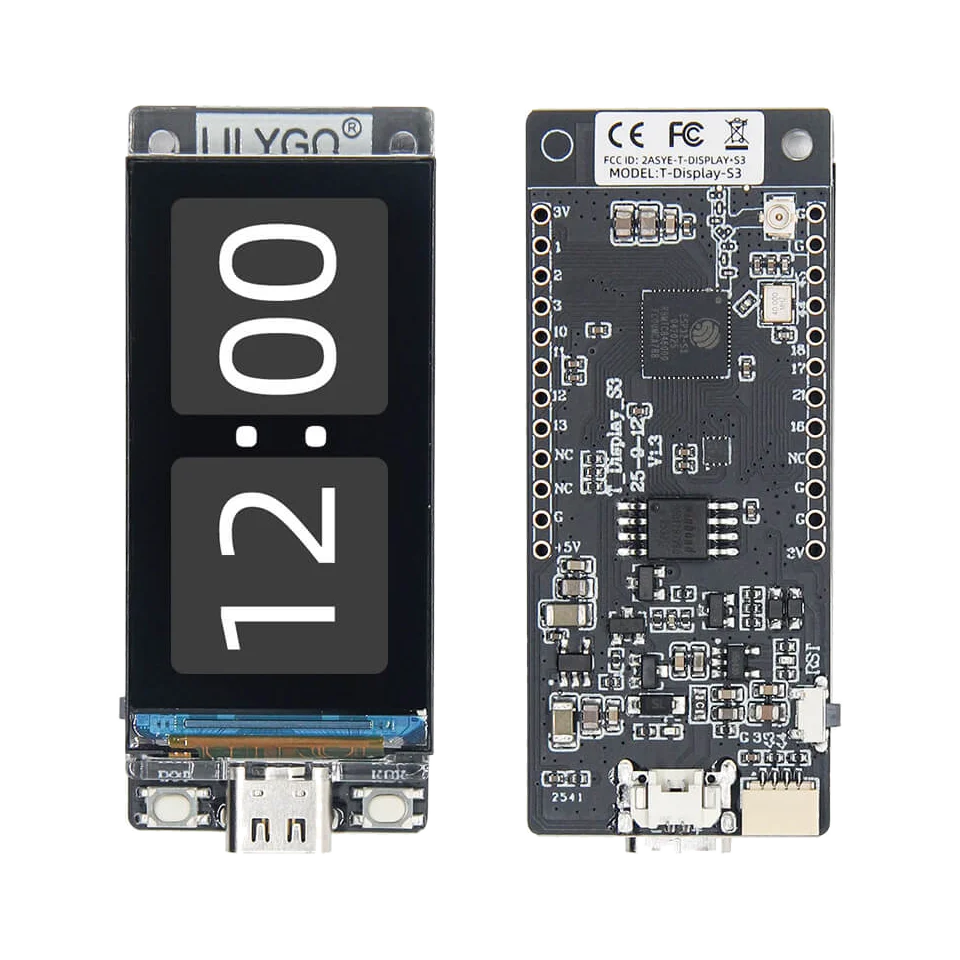
Board-specific guide for T-Display S3 firmware, display status workflows, Qwiic/I2C checks and ESP32-S3 workflows.
wiring references
T-Display S3 pinout, header and board photos
Four wiring references for T-Display S3 pinout checks, side headers, buttons, USB-C and board orientation.
compatibility
T-Display S3 board overview
Use this page to judge T-Display S3 for display-assisted ESP32 Bit Pirate checks in a compact board format.
practical tasks
T-Display S3 supported workflows
T-Display S3 works well for Qwiic I2C, USB serial, GPIO checks and workflows that benefit from visible device feedback.
Scan sensors and EEPROM-style devices through the connector when voltage and pullups are correct.
Use USB connection for CLI access and browser-based terminal checks.
Use exposed pins for SPI probes, pulse, listen and measure tasks with planned wiring.
Use the display-oriented form factor when feedback on the device matters.
T-Display S3 pin mapping and wiring notes
Avoid pins consumed by the display and buttons. Use the Qwiic connector for I2C workflows and confirm any exposed pin before using it as a generic DIO/SPI/UART signal.
Always verify voltage and pin mapping before connecting a target. The ESP32-S3 side is not 5 V tolerant unless external level shifting or the Dock path is used correctly.
useful pages
T-Display S3 useful next pages
Jump from T-Display S3 to display-friendly serial, I2C, GPIO and flashing resources.
Protocol modes
Useful recipes
Use the task guide for wiring, commands and troubleshooting.
Bridge UART consoleUse the task guide for wiring, commands and troubleshooting.
Measure GPIO frequencyUse the task guide for wiring, commands and troubleshooting.
Choose GPIO pinout before wiringUse the task guide for wiring, commands and troubleshooting.
Tools and hardware
Open Web Serial for T-Display S3 CLI sessions after flashing.
Web FlasherFlash the matching T-Display S3 build from a compatible browser.
Hardware ecosystemCheck docks, adapters and wiring hardware that pair with T-Display S3.
Modules and target chipsBrowse chips and breakout modules that make sense with T-Display S3 wiring.
board-specific answers
T-Display S3 FAQ
Quick T-Display S3 answers about display feedback, Qwiic I2C, SPI clips and DevKit tradeoffs.
Is T-Display S3 supported by ESP32 Bit Pirate?
Yes. It has a supported board page and dedicated Web Flasher route.
What is the main advantage of T-Display S3?
The integrated display gives visible feedback while keeping a compact footprint.
Can I use Qwiic I2C devices?
Yes, Qwiic I2C workflows are a natural fit when the device voltage and pullups are compatible.
Is it better than DevKit for wiring?
No. DevKit is still cleaner when you need labeled headers, many simultaneous signals or repeatable bench wiring.
Should I use it for SPI flash clips?
Only when the needed pins are safely available. DevKit or Dock is usually cleaner for flash clip work.
How do I enter download mode?
With USB connected, hold BOOT, press and release RESET, then release BOOT.
source project
T-Display S3 in the ESP32 Bit Pirate ecosystem
ESP32 Bit Pirate on T-Display S3 pairs browser flashing and serial access with onboard display feedback for compact bench workflows.