Wrong x8/x16 assumptions make dumps look scrambled.
Microwire memory target
93Cxx Microwire EEPROM reading and writing on ESP32
Wire 93Cxx Microwire EEPROM chips to ESP32 or ESP32-S3 and use ESP32 Bit Pirate to open the dedicated 3-Wire EEPROM shell for probe, read bytes, dump EEPROM, write bytes and erase actions.
Start here when connecting a 93Cxx or Microwire EEPROM to ESP32 for chip identification, organization checks and read-first memory debugging. Confirm the device family before any write or erase operation.
- 93Cxx
- Microwire
- read
- write
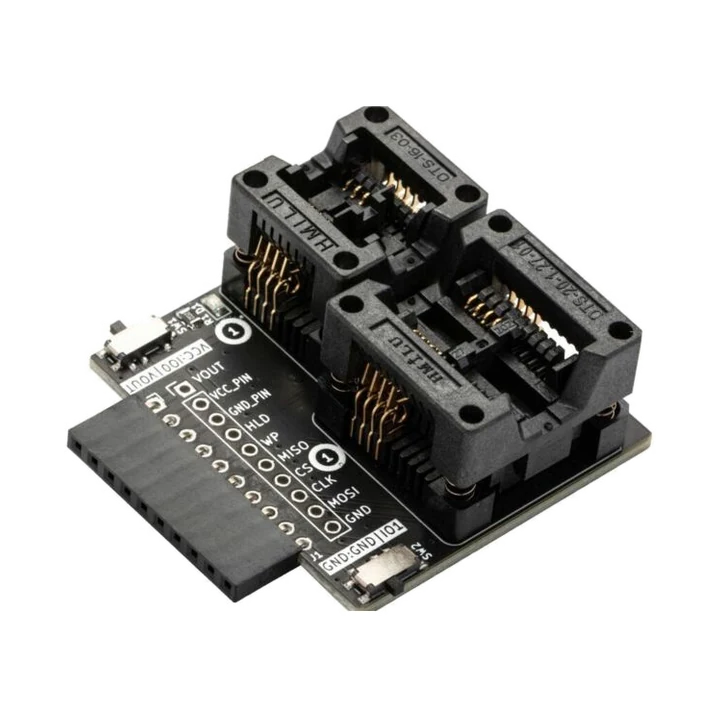
reading and writing
Start with 93Cxx probe and backup
Confirm the 93Cxx part number, voltage and x8 or x16 organization before writing. Probe the EEPROM first, then read bytes or create a full dump before any write-enable, erase or patch action.
- 01
Identify the exact 93Cxx chip and whether it is organized as x8 or x16.
- 02
Confirm VCC, GND, CS, CLK, DI and DO pins before powering the chip.
- 03
Open the dedicated
eepromshell and start with Probe to confirm size and x8/x16 organization. - 04
Use Read bytes or Dump EEPROM from the shell before write/erase actions.
- 05
Use erase only on lab chips or devices you are authorized to modify.
Example CLI flow
mode 3wire
config
eeprom       # open the 3-Wire EEPROM shell
Use this as a reading and writing preview. Inside the EEPROM shell, start with Probe, then use Read bytes or Dump EEPROM before any write or erase action.
hardware reminders
93Cxx EEPROM wiring notes before power
Confirm the 93Cxx package, x8 or x16 organization, CS/SK/DI/DO pins and safe supply before clipping onto the EEPROM.
Wiring View
93Cxx variants and packages differ; check the datasheet.
Write/erase flows often require explicit enable steps.
Before wiring a module or target chip, check pinout, voltage, ground reference and whether the selected ESP32-S3 board has the required pins free.
task-level guides
Detailed 93Cxx Microwire EEPROM recipes
Use these 93Cxx guides for Microwire wiring, probe, dump, byte patching and safe lab erase steps.
what it is
What 93Cxx EEPROM is used for
93Cxx EEPROMs use Microwire / 3-wire-style signalling and are common in small configuration storage and legacy embedded targets.
practical value
Why use 93Cxx EEPROM with ESP32 Bit Pirate
ESP32 Bit Pirate gives these chips a focused 3-Wire EEPROM shell for probing organization, reading bytes, dumping contents and performing controlled lab writes/erases.
common symptoms
Common problems with 93Cxx Microwire EEPROM
93Cxx failures usually come from chip organization, CS/CLK/DI/DO wiring, voltage or write-enable state. Check those before changing memory.
Read returns all FF
Check CS, DO line, power and organization.
Data looks interleaved
The x8/x16 organization may be wrong.
Write does nothing
Check write-enable behavior and whether the chip or board protects writes.
pages
Useful 93Cxx EEPROM next pages
Jump from 93Cxx EEPROM wiring to the 3-Wire protocol, dump/write recipes and hardware notes for safe bench work.
3-Wire
Protocol overview for 3-Wire EEPROM reading and writing.
ESP32-S3 DevKitBoard-specific notes for using 93Cxx Microwire EEPROM with ESP32 Bit Pirate.
Dump Microwire 93C EEPROMUse the 3-Wire EEPROM shell dump action after Probe.
Write 93Cxx EEPROM bytesPatch bytes on a lab 93Cxx EEPROM safely.
Erase lab 93Cxx EEPROMClear a reusable Microwire EEPROM target.
Web Serial TerminalUse Web Serial for 3-Wire EEPROM probe, dump and byte-write commands.
Hardware ecosystemDock, adapters, level notes and physical hardware context.
module-specific answers
93Cxx Microwire EEPROM FAQ
Quick answers about 93Cxx organization, 3-Wire wiring, EEPROM dumps and safe erase/write checks.
Can ESP32 Bit Pirate read 93Cxx EEPROMs?
Yes. Use mode 3wire, configure the pins, then open the dedicated eeprom shell.
Why does organization matter?
93Cxx chips can expose x8 or x16 organization, which changes how data should be interpreted.
Can I erase a chip?
Only on lab chips or targets you are authorized to modify, after taking a backup.
Is this I2C?
No. 93Cxx EEPROMs use Microwire / 3-Wire-style signalling, not I2C.
Where should I start?
Start with the 3-Wire protocol page and the EEPROM shell Probe action.
project
93Cxx EEPROM inside ESP32 Bit Pirate.
The 93Cxx EEPROM page links Microwire protocol notes, dump/write recipes, board wiring and browser serial access for safe memory work.